The Activewear Fabric Weight Mismatch Nobody Warns You About
Quick Answer: Activewear fabric that’s too heavy for a high-heat, high-intensity sport traps sweat and overheats you, while fabric too light for a high-friction, high-compression sport wears out fast and under-supports — matching fabric weight to your specific activity matters more than most people realize when shopping.
You bought a great-looking set, but somehow it always feels wrong for what you’re actually doing in it. The issue is often fabric weight, not fit.
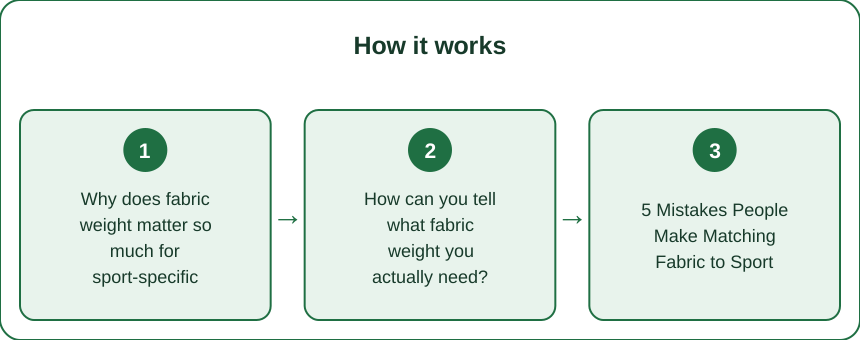
Why does fabric weight matter so much for sport-specific performance?
Heavier, more compressive fabrics (common in cycling or weightlifting gear) provide more structural support and muscle stabilization but breathe less and trap more heat, making them a poor match for something like hot yoga or distance running where heat dissipation matters more. Lighter, more breathable fabrics (common in running gear) prioritize airflow and moisture-wicking over structural compression, which can under-support a high-impact activity like HIIT or heavy lifting.
Using a set built for one intensity and heat profile in a very different activity is a common reason people feel like their “good” activewear somehow underperforms for a specific workout, even though the same set feels great for a different type of session.
How can you tell what fabric weight you actually need?
Consider both heat output and impact level of your primary activity: high-heat, moderate-impact activities (yoga, Pilates, barre) generally do best with lighter, more breathable fabric, while high-impact, moderate-heat activities (HIIT, weightlifting, sled work) benefit from heavier, more compressive fabric for support even at some breathability cost. Activities that are both high-heat and high-impact (like intense outdoor HIIT in summer) often require a compromise, sometimes solved with strategic mesh paneling that adds breathability to specific zones without sacrificing overall structure.
Checking a product’s stated GSM (grams per square meter) fabric weight, when listed, gives a more objective comparison point than descriptive marketing language like “buttery soft” or “second skin,” which doesn’t reliably indicate actual weight or breathability.
5 Mistakes People Make Matching Fabric to Sport
- Buying based on how a fabric feels in a fitting room rather than how it performs under actual sweat and heat
- Assuming compression always means better support regardless of the activity’s actual impact level
- Using heavy cycling or lifting gear for hot yoga or running, causing overheating
- Using ultra-light running gear for heavy lifting, missing structural support where it matters
- Ignoring mesh panel placement, which can meaningfully change how a single garment performs across different activity types
Does this mean you need separate activewear for every sport?
Not necessarily entirely separate wardrobes, but having at least two general fabric-weight categories — one lighter, breathable set for heat-heavy or lower-impact activities, and one heavier, compressive set for high-impact or support-heavy activities — covers most people’s range of activities reasonably well without needing highly specialized gear for every single sport. Cross-training athletes with a genuinely wide activity range benefit most from having both categories available rather than relying on a single all-purpose set.
For people with one dominant primary activity, matching their main set closely to that activity’s specific heat and impact profile matters more than diversifying across many fabric weights they’ll rarely need.
FAQ: Activewear Fabric Weight Questions, Answered
Is heavier fabric always better quality than lighter fabric?
No — weight reflects a different performance tradeoff (support versus breathability), not a quality hierarchy; the right choice depends entirely on the activity.
What does GSM mean and why does it matter?
Grams per square meter measures fabric weight objectively — higher GSM generally means heavier, more structured fabric; lower GSM means lighter, more breathable fabric.
Can mesh paneling fix a fabric that’s the wrong weight for an activity?
It helps meaningfully for borderline cases, but doesn’t fully substitute for choosing a base fabric weight suited to the activity’s actual heat and impact demands.
TL;DR:
- Heavier, compressive fabric supports high-impact activity but traps heat during high-heat sessions
- Lighter, breathable fabric handles heat well but under-supports high-impact movement
- Check GSM fabric weight when listed, rather than relying on descriptive marketing language
- Two general fabric-weight categories cover most people’s range of regular activities
Next time a set feels wrong for a specific workout, check whether it’s a fabric weight mismatch before assuming it’s a fit or brand quality issue.
Keep Reading
This article is for general informational and styling purposes only. Fit, sizing, and product availability may vary.