Why Buying for Your Hardest Session Leaves You Underdressed for the Rest
Quick Answer: Kit chosen for maximum output is optimised for heat dumping and sweat management, which are the wrong priorities for the sessions that make up most of your week — easy runs, mobility, strength work, walks. Those are lower-output and often longer, which means you get cold rather than hot. Build the wardrobe around your median session, not your hardest one, and treat the hard-session kit as the specialist item it is.
You probably do one genuinely hard session a week.
And you probably own a drawer optimised for it.

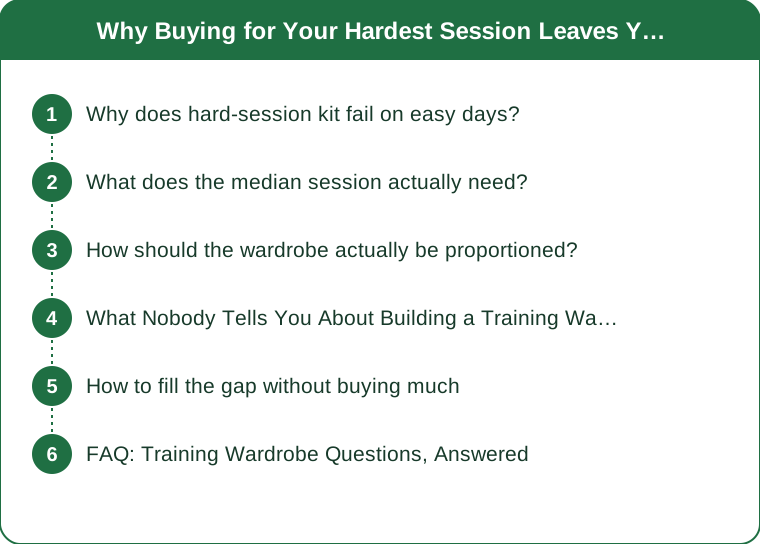
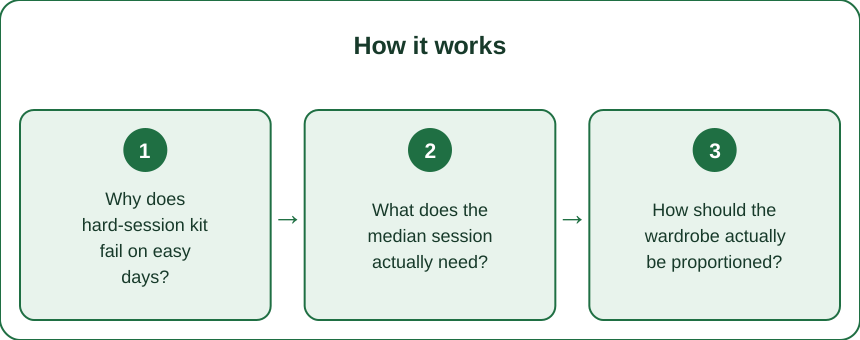
Why does hard-session kit fail on easy days?
Because it is solving the opposite problem.
During a hard session, your body produces a large amount of heat and sweat, and the job of the fabric is to move both away as fast as possible. That means light, thin, highly breathable, minimal insulation — every design decision points towards getting heat out.
During an easy session, heat production is far lower. The same fabric now has nothing to dump, and its excellent breathability becomes excellent heat loss. You end up cold, particularly at the extremities and particularly if there is any wind.
Three factors make this worse than people expect:
Easy sessions are often longer. An hour of easy running or a ninety-minute walk gives cold considerably more time to accumulate than a twenty-five-minute interval session does.
They involve more standing still. Strength work, mobility, and anything with rest periods means repeated cycles of warming and cooling, which thin fabric handles badly.
Slight dampness turns into real cold. A light sweat in an ultra-thin fabric evaporates fast, and evaporation is cooling. In a hard session that is exactly what you want. Standing between sets, it is not.
So the kit is not bad. It is specialised, and it is being used outside its specialisation on most days of the week.
What does the median session actually need?
Different priorities, and most people have never articulated them.
Moderate insulation rather than minimum. Enough fabric to retain some heat when output is low, without being so much that you overheat when it rises.
Some wind resistance. A significant share of the cold you feel on an easy outdoor session is wind cutting through open-knit fabric. A slightly denser knit or a light windproof panel changes the experience disproportionately.
Tolerance for stopping and starting. Which means slightly heavier fabric that does not chill the moment you pause.
Comfort over hours rather than minutes. Seam placement, waistband comfort and chafe resistance all matter far more at ninety minutes than at twenty-five. A garment that is superb for a short hard effort can be genuinely uncomfortable across a long easy one.
Range of use. Median-session kit gets worn for the gym, the walk, the errand and the class. It benefits from looking unremarkable in a way that a race vest does not.
In practical terms this usually means mid-weight fabric rather than the lightest available, a slightly closer knit, and long-sleeve options that are not thermal. It is the least exciting category in any activewear range and it is what most people should own the most of.
How should the wardrobe actually be proportioned?
Roughly in line with how you train, which almost nobody does.
A reasonable structure for someone training four to six times a week:
Median-session kit: about 60% of what you own. Mid-weight, versatile, comfortable for long durations. This is what you wear on most days and it should be what you have most of.
Hard-session kit: about 20%. Light, breathable, cut for output. Two sets is plenty for one or two hard sessions a week.
Cold or wet specialist kit: about 20%. Wind layer, thermal layer, gloves, a hat. Used occasionally and essential when needed.
Most people’s actual distribution is close to the reverse: a lot of light performance kit bought aspirationally, one hoodie, and nothing in the middle.
The reason is straightforward — hard-session kit is what gets marketed, photographed and reviewed. It is the interesting end of the category. Mid-weight long-sleeve tops are not interesting and they are what you will wear a hundred times.
A useful audit: look at what you wore for your last ten sessions. If the same two garments appear seven times, those are your median items and you probably need another two of them more than you need anything else in your basket.
What Nobody Tells You About Building a Training Wardrobe
The most-worn item is almost never the most expensive one. People consistently find their highest cost-per-wear items are specialist pieces bought for conditions they meet three times a year, and their lowest are plain mid-weight items bought without much thought.
Fit matters more at low intensity than high. During a hard effort you notice very little. On a long easy session you notice a seam, a waistband, a strap. Comfort tolerances are tighter for the sessions people spend the least on.
You need more of the boring things, not more variety. Three identical mid-weight tops beat three different ones, because you always know what you are getting and laundry timing stops being a factor in what you wear.
Layering beats single-purpose garments. Two mid-weight layers cover a much wider range of conditions than one heavy one, and they let you adjust mid-session, which single garments never do.
Colour affects use more than people admit. Kit that looks fine walking into a shop gets worn for more of the week than kit that only works in a gym. That is not vanity; it is utilisation.
The gap shows up in the first cold weeks, every year. This is the pattern almost everyone repeats — a summer wardrobe of light kit works right up until the first genuinely cool morning, at which point people jump straight to a heavy winter layer and spend the whole of autumn alternating between too cold and too hot, because the mid-weight layer that would cover the entire transition is the one nobody bought.
How to fill the gap without buying much
Five steps, and most of them cost nothing.
1. Audit your last ten sessions. Write down what you actually did and what you wore. This takes five minutes and it usually reveals the imbalance immediately.
2. Identify your median session honestly. Not the one you aspire to. The one you did four times this month. That is what to buy for.
3. Buy two mid-weight long-sleeve tops before anything else. If there is one gap in almost every training wardrobe, it is this. They cover autumn entirely, they work as a layer in winter, and they get used year-round.
4. Add a light wind layer rather than a warm one. Wind resistance does more for perceived warmth on an easy outdoor session than insulation does, and a packable wind shell is usable across a far wider temperature range than a thermal.
5. Stop replacing hard-session kit you already have enough of. Two sets is genuinely sufficient for one or two hard sessions a week, and it is the category most likely to be over-bought.
And one reframe worth holding onto: the fabric weight should match the intensity, not the outdoor temperature. A cold-weather high-intensity session may want lighter kit than a mild-weather easy one, because output matters more than air temperature for how much heat you are producing. People dress for the thermometer and then wonder why they overheat during intervals in November and freeze on an easy jog in September.
Which, as the mornings cool over the next few weeks, is the single most useful thing to get right — check your session before you check the forecast.
FAQ: Training Wardrobe Questions, Answered
How do I know what counts as mid-weight?
Fabric weight is often listed in grams per square metre, and mid-weight for training tops broadly sits in the 150 to 220 range. If it is not listed, hold it up to light — if you can read text through it easily, it is a hard-session fabric.
How many sets of activewear do I actually need?
Enough that laundry timing never dictates whether you train — usually four to six sets for someone training four to six times a week. The composition matters more than the number.
Should I buy separate kit for the gym and for outdoors?
Generally no, with one exception: outdoor sessions benefit from wind resistance that is unnecessary and slightly uncomfortable indoors. One wind layer covers that rather than a separate wardrobe.
Is expensive activewear worth it?
For high-output specialist kit, sometimes — fabric technology genuinely differs. For mid-weight everyday items, the return drops off quickly and consistency matters more than performance.
What is the one item most people are missing?
A mid-weight long-sleeve top. It is unglamorous, it covers the entire autumn transition, and it works as a base layer in winter. Almost every under-equipped training wardrobe has this exact gap.
How do I stop overheating during hard sessions in winter?
Dress for about ten minutes into the session rather than for the first minute. Being slightly cold at the start is correct, and it is the single most common winter dressing error to correct for.
TL;DR:
- Hard-session kit is built to dump heat, which is the wrong priority for the lower-output sessions filling most of your week
- Easy sessions are longer and involve more stopping, so cold accumulates in fabric designed to shed it
- Aim for roughly 60% median-weight kit, 20% hard-session, 20% cold and wet specialist
- Wind resistance does more for perceived warmth on easy outdoor sessions than insulation does
- Match fabric weight to intensity rather than to the thermometer — output decides how much heat you produce
Write down what you wore for your last ten sessions. If two garments account for most of it, buy another one of those before anything else in your basket.
Keep Reading
This article is for general informational and styling purposes only. Fit, sizing, and product availability may vary.