Why Your Training Kit Fails on the Walk Home, Not During the Session
Quick Answer: During a session your body produces a lot of heat and your kit is designed to move it away. The moment you stop, heat production drops sharply while the evaporation keeps going, so the same garment that was perfect becomes a cooling system you cannot switch off. The fix is a dry layer to change into and a windproof shell, not warmer training clothes.
The session was fine. You were comfortable the whole way through.
Then you stepped outside and within four minutes you were properly cold, in a way that took an hour and a hot shower to fix.
Your kit did not fail. It kept doing exactly what it was built to do at the point when you needed it to stop.
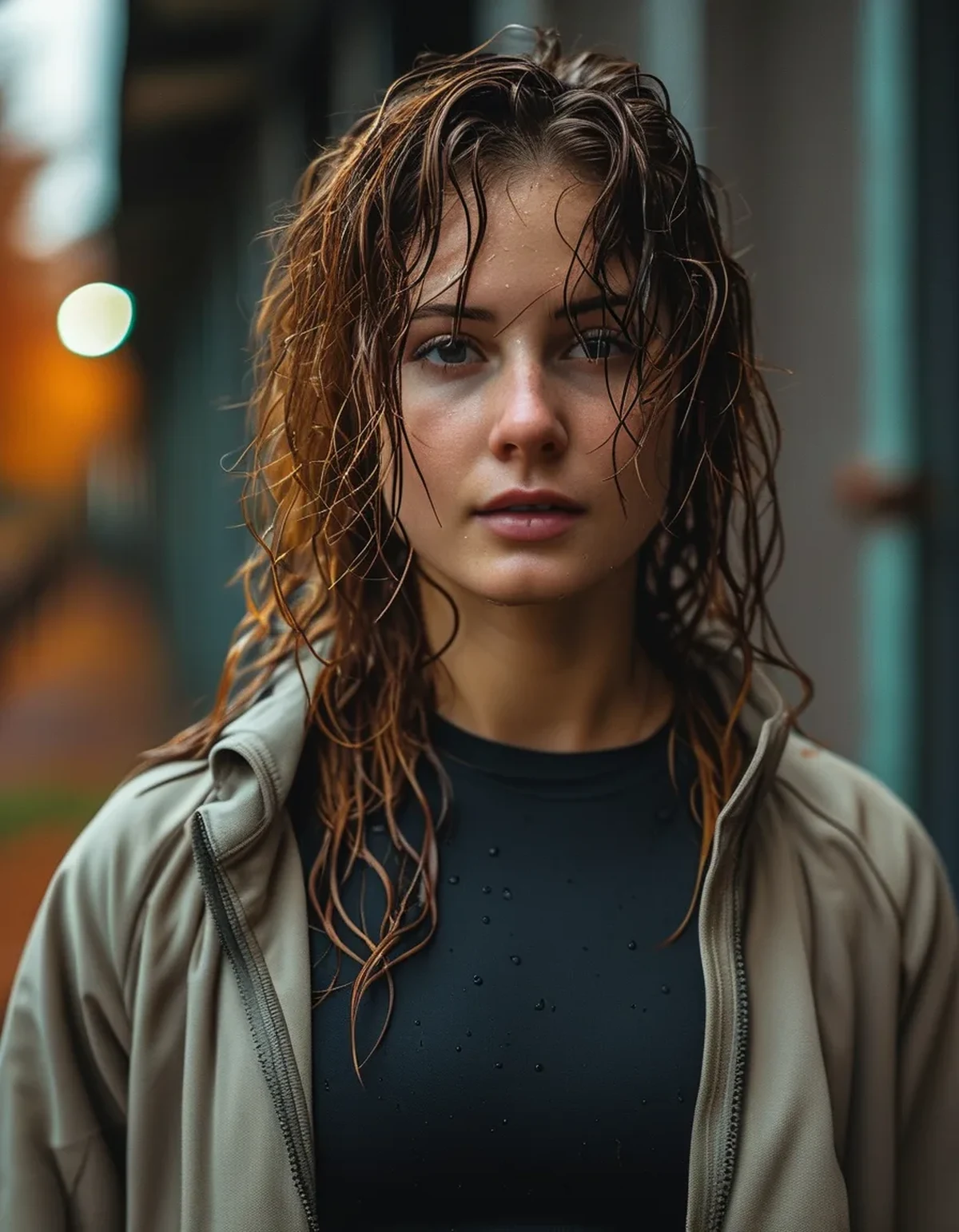
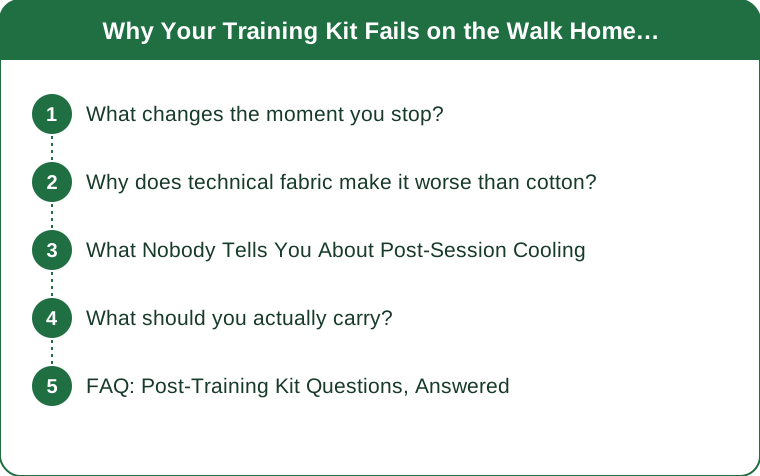
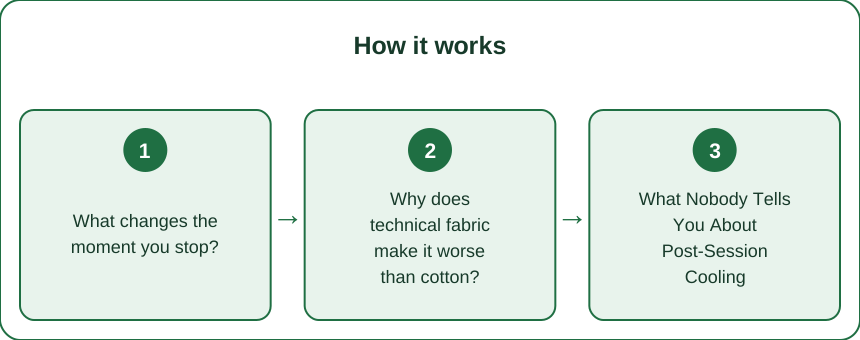
What changes the moment you stop?
Your heat production falls off a cliff and your heat loss does not.
During hard exercise your body produces several times its resting heat output. Technical fabric is engineered around that: it moves sweat to the outer surface where it evaporates, and evaporation carries heat away. At full output, that is exactly what you want.
When you stop, heat production returns toward baseline within a few minutes. The evaporation, however, continues at close to the same rate, because there is still a significant amount of water sitting in and on the fabric.
So you now have a cooling system running at exercise capacity attached to a body producing resting heat. That imbalance is the entire phenomenon, and it is why the drop feels so abrupt.
Two things make it worse in autumn. Cool air increases the rate of evaporation, and wind increases it dramatically - a light breeze through a damp technical top removes heat many times faster than still air does.
And the surface area involved is large. A soaked base layer is in contact with most of your torso, which is where you least want to be losing heat.
Why does technical fabric make it worse than cotton?
This is the counterintuitive part, and it is worth understanding because it changes what you carry.
Cotton holds water inside the fibre and releases it slowly. That is why cotton is a poor training fabric - it gets heavy, stays wet, and chafes. It is also why a cotton t-shirt cools you more slowly after a session; it is bad at evaporating, which is a disadvantage during and an advantage after.
Technical synthetics are the reverse. They hold very little water within the fibre and move it to the surface where it evaporates fast. Excellent during, and it means a synthetic top is a highly efficient evaporative cooler for the fifteen minutes after you stop.
So the better your kit performs during the session, the sharper the post-session drop. People who upgrade from cotton to good technical layers often notice this and assume the new kit is thin or poor quality.
The answer is not worse fabric. It is a dry layer. Nothing you can wear during a session solves a problem caused by that garment being wet - it has to come off, or something has to go over it.
Merino sits between the two and is the closest thing to a compromise, since it holds more water in the fibre and evaporates more slowly while still performing during exercise.
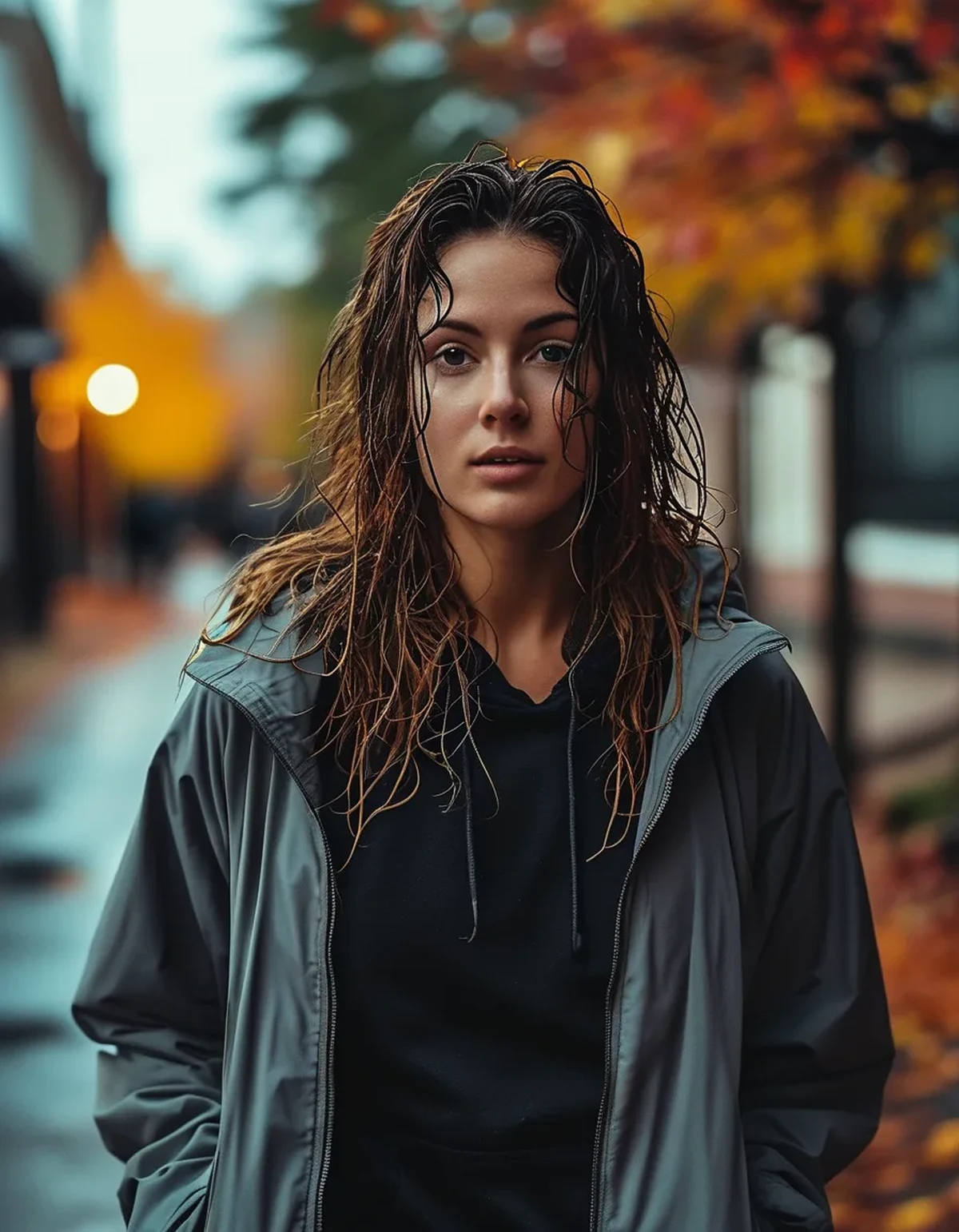
What Nobody Tells You About Post-Session Cooling
The danger zone is longer than the walk. Core temperature keeps dropping for a while after you stop, and a substantial after-drop can arrive twenty or thirty minutes later - often once you have got home and sat down. Getting out of damp kit promptly matters more than the coat you wore for the walk.
Your head and hands cool fastest and cost least to fix. A thin hat and gloves in a bag weigh nothing and address the two areas with the highest heat loss per unit of effort. In autumn this is the highest-value thing in the bag.
Wind is the variable that matters, not temperature. A windproof shell over a damp top transforms the walk home at 50F far more than an insulated layer does, because it stops the air movement that is driving evaporation. A cheap packable windbreaker outperforms a much warmer fleece here.
Sitting in a car is not safe. People assume being out of the wind solves it. A cold car seat and a damp base layer with no heat production is a slow version of the same problem, and it is where a lot of the post-session chill actually happens.
And the shower is not the fix people think it is. A hot shower feels excellent and rewarms the skin far faster than the core. Feeling warm within two minutes of getting in is not the same as being warm, which is why some people get cold again after drying off. Getting dry and dressed is more effective than getting hot.
What should you actually carry?
Four items handle almost all of it, and none of them are training clothes.
A dry base layer to change into. The single most effective item, and the one most people skip because changing is inconvenient. Sixty seconds of swapping a wet top for a dry one does more than any outer layer.
A packable windproof shell. Not insulated, not waterproof necessarily - just windproof. It stops evaporative cooling more effectively than anything with a warmth rating and it packs down to nothing.
A thin hat and light gloves. Disproportionate return for the space they take.
Dry socks if you have been outdoors. Feet get cold last and stay cold longest, and damp socks in the car undo everything else.
And a few habits worth having:
Put the layer on before you feel cold, not after. Once the drop has started, adding a layer over damp clothing traps cold rather than adding warmth. The moment to do it is the moment you stop.
Do not stand around in a damp top. The stretching, the chatting, the phone-checking after a session all happen at the worst possible moment thermally. Change first, then do those things.
Adjust for the season rather than the day. The same 55F feels entirely different in September, when you are acclimatised to warmth, than in March. Autumn is the season people underdress for most consistently, because the number on the forecast has not yet caught up with what their body is used to.
FAQ: Post-Training Kit Questions, Answered
Should I buy heavier training clothes for autumn?
Usually not. Heavier kit makes the session worse and does not fix the post-session problem, since the issue is that the garment is wet. Keep the same training layers and add a dry change and a shell.
Is merino actually worth the money for this?
For the walk home specifically, yes - it evaporates more slowly and holds warmth better when damp than synthetics. For hard training it is more debatable, since it dries slower and wears out faster. Many people use synthetic for the session and merino as the layer they change into.
Does this matter indoors?
Less, but more than you would expect in a cool gym or a studio with air conditioning. The same mechanism applies wherever there is moving air, which is why the machine directly under a vent is always the coldest place in the room once you finish.
TL;DR:
- When you stop, heat production drops sharply but evaporation from wet kit continues, turning your best layer into a cooling system.
- Good technical fabric makes this worse than cotton, because it evaporates more efficiently.
- A dry base layer to change into and a packable windproof shell beat any amount of extra warmth.
- Add the layer the moment you stop, not once you feel cold, and do not stand around damp.
The kit is not too thin. It is wet, and the fifteen minutes after a session is a different problem from the hour before it.
Keep Reading
This article is for general informational and styling purposes only. Fit, sizing, and product availability may vary.