How to Layer Activewear by Sport (Not Just by Temperature)
Quick Answer: Layer based on your sport’s heat output, not just the outside temperature — high-output activities (running, HIIT) need less insulation than the thermometer suggests since you’ll generate heat fast, while lower-output activities (walking, yoga outdoors) need more, since you won’t warm up the same way.
You check the temperature, dress accordingly, and 10 minutes into your run you’re already peeling off a layer — or 10 minutes into a slow outdoor walk you’re shivering in the exact same jacket that felt fine for your last run. The thermometer was never the right variable.
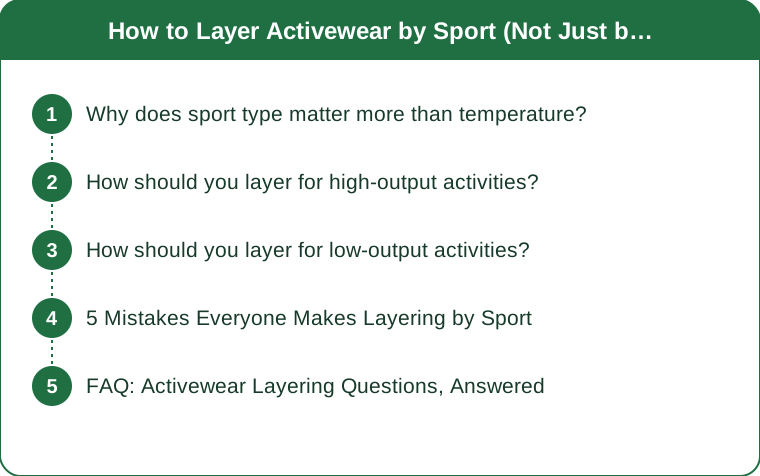
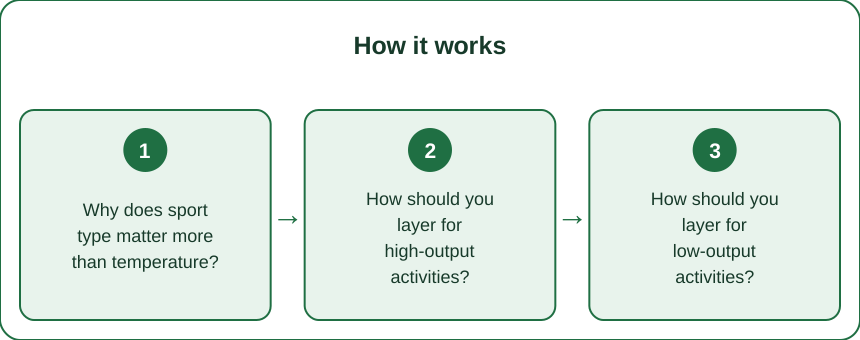
Why does sport type matter more than temperature?
Because metabolic heat output varies dramatically by activity. A running session at 40°F can feel like 55-60°F within 10 minutes once your body’s generating heat, while a walk at the same 40°F stays close to actual ambient temperature the whole time.
Dressing for the thermometer instead of the activity is the single most common layering mistake — it’s why runners consistently overdress and walkers consistently underdress in identical weather.
How should you layer for high-output activities?
Dress for feeling slightly cold for the first 10 minutes — if you’re comfortable standing still at the start line, you’ll be overheating by minute 15. A base layer plus a light wind shell you can tie around your waist covers most conditions down to freezing.
Avoid heavy insulating layers for running, HIIT, or cycling in anything above freezing — your own heat output does most of the insulating work once you’re moving.

How should you layer for low-output activities?
Dress for actual comfort at rest, since you won’t generate much extra heat. Walking, outdoor yoga, and casual outdoor stretching need a genuine insulating mid-layer plus wind protection well before running or HIIT would.
The fabric-weight mistake here runs the other direction from high-output sports: too-light layers leave you cold the entire session instead of overheating mid-way through.
5 Mistakes Everyone Makes Layering by Sport
1. Copying a running layering system for walking — walkers need roughly one full layer more than runners at the same temperature.
2. Cotton base layers for any high-sweat activity — cotton holds moisture against skin and chills you fast once you slow down.
3. No wind layer for cycling — wind chill from movement speed matters far more on a bike than on foot.
4. Over-layering for indoor classes held in unpredictable room temperatures — check the studio’s typical heat level before assuming outdoor rules apply.
5. Ignoring the cool-down window — post-workout, sweat-soaked layers chill you fast even in mild weather; pack a dry layer to change into.
FAQ: Activewear Layering Questions, Answered
What’s a good rule of thumb for cold-weather running?
Dress as if it’s 15-20°F warmer than the actual temperature — your running heat output covers that gap within the first mile.
Do I need different layering for cycling than running at the same temperature?
Yes — wind chill from cycling speed is significant, so cyclists generally need a wind-resistant layer that runners at the same temperature can skip.
How do I layer for a workout that mixes high and low output, like interval training?
Layer in easily removable pieces (zip-front, tie-around-waist) so you can shed and re-add as intensity shifts within the same session.
TL;DR:
- Layer for your sport’s heat output, not the thermometer alone
- High-output activities (running, HIIT): dress slightly cold at the start, you’ll warm up fast
- Low-output activities (walking, outdoor yoga): dress for actual comfort at rest
- Skip cotton base layers, add wind protection for cycling, and pack a dry layer for post-workout
Match the layering system to the sport’s heat curve, not just the weather app — it’s the difference between comfortable and either soaked or shivering by minute 10.
Keep Reading
This article is for general informational and styling purposes only. Fit, sizing, and product availability may vary.