How to Layer for Training in the First Cold Weeks Without Overdressing
Quick Answer: Dress for roughly 10 to 15F warmer than the actual temperature, because you generate substantial heat within the first ten minutes. You should feel slightly cold standing at the door - if you feel comfortable there, you are overdressed. Prioritise a wind-resistant outer layer over a thick one, cover the extremities since hands and ears lose comfort first, and choose a layer you can remove and carry rather than one you are committed to.
You stood at the door feeling perfectly comfortable, which was the mistake.
Twelve minutes later you were carrying a jacket and regretting the long sleeves underneath it.
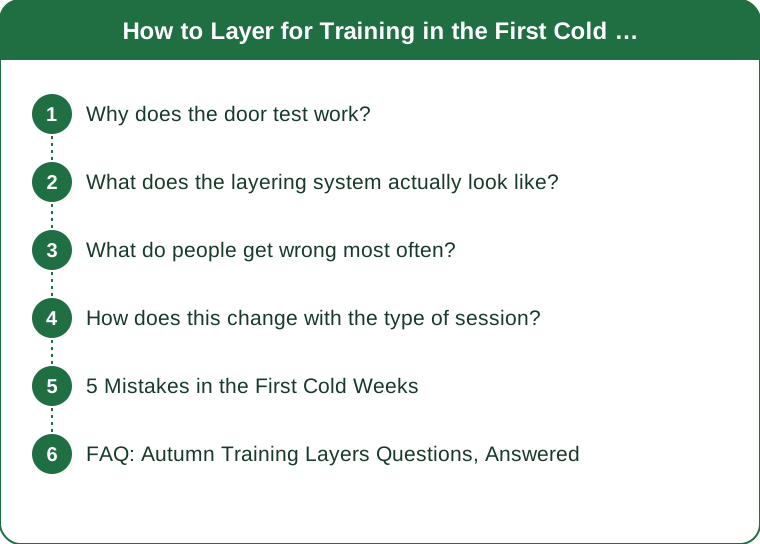
Why does the door test work?
Because you produce a large amount of heat once you start moving, and that heat production rises for the first five to ten minutes before stabilising.
Dressing to feel comfortable at rest means dressing for the wrong condition, since rest is the only part of the session where you are not generating heat.
The commonly used rule is to add 10 to 15F to the actual temperature when deciding what to wear.
Which produces the slightly-cold-at-the-door feeling that people find counterintuitive and that works reliably.
Overdressing produces sweat, which then chills you once you slow down or stop, so it makes you colder rather than warmer overall.
The exception is genuinely cold conditions or long slow efforts, where you generate less heat and need more insulation.
What does the layering system actually look like?
Base layer: moisture management first, warmth second. Technical synthetic or merino, close fitting. Cotton is the layer to avoid because it holds moisture against the skin.
Mid layer: insulation, and only when needed. A long-sleeve technical top is enough for most autumn conditions, and this layer is often unnecessary above about 50F when moving.
Outer layer: wind and water resistance rather than thickness. Wind is what makes cold feel cold, and a thin windproof shell outperforms a thicker non-windproof layer at a fraction of the bulk.
Extremities: gloves, ear cover, and a buff. These are what make the first ten minutes tolerable and they pack away to nothing.
The principle is removability. Two thin layers you can adjust beat one thick layer you cannot.
And a small pocket or waist pack turns a removed layer from a burden into a non-issue.
What do people get wrong most often?
Overdressing the torso and underdressing the hands and ears, which is almost universal in the first cold weeks.
Hands and ears lose comfort fastest because they are peripheral and poorly insulated, and they are also the cheapest and lightest thing to cover.
Choosing a thick jacket over a windproof one, which produces overheating on still days and inadequate protection on windy ones.
Wearing cotton as a base, which holds sweat and becomes cold and heavy.
Not accounting for wind direction, since an out-and-back run means you are exposed on one leg and sheltered on the other - and the return leg into the wind, wet with sweat, is the cold one.
And dressing the same for an easy run and a hard session, when heat production differs substantially between them.

How does this change with the type of session?
Hard sessions and intervals: dress lighter. Heat production is high, and you will be uncomfortable within minutes if you dress for the temperature.
Easy runs and long slow efforts: dress slightly warmer, since you produce less heat and are out for longer.
Sessions with standing rest - intervals with recovery, or track work - need a layer to put on between efforts, because you cool fast when you stop.
Strength or gym work outdoors: a removable layer is essential, since the work-to-rest pattern swings your temperature repeatedly.
Cycling needs considerably more than running at the same temperature, because speed increases windchill substantially.
And walking needs more again, which is why people who walk to a session and then run should plan for two different requirements.
5 Mistakes in the First Cold Weeks
1. Dressing to feel comfortable at the door. The single most common error. You should feel slightly cold before you start, and if you feel good standing still you have overdressed for moving.
2. A thick jacket instead of a windproof one. Wind is what makes cold uncomfortable. A thin shell that blocks it outperforms a thick fleece that does not, and packs down to nothing.
3. Bare hands and ears. They are the first to be uncomfortable, they ruin the first fifteen minutes, and covering them costs almost nothing in weight or bulk. Most people insulate their torso twice over while leaving these bare.
4. Cotton anywhere in the system. It absorbs sweat, stops insulating and becomes a cold wet layer against the skin. It is the one material worth eliminating entirely.
5. Not planning for the return leg. Going out with the wind and coming back into it, wet with sweat, is where people get properly cold. Plan the route so the exposed section comes first, while you are dry.
And the bonus one: forgetting that you will stop. The walk home, the wait for a lift, standing about afterwards - that is when you get cold, and a packable extra layer solves it.
FAQ: Autumn Training Layers Questions, Answered
How much warmer should I dress for than the actual temperature?
Roughly 10 to 15F warmer is the common guideline for running. Adjust down for hard sessions and up for easy or long efforts.
What temperature do I need long sleeves?
Highly individual, but many runners switch around 50 to 55F for easy running and lower for hard sessions. Use it as a starting point and adjust based on the door test.
Is merino worth it?
Many people find it useful for its warmth when damp and its odour resistance. Synthetic base layers generally dry faster and cost less. Both work; cotton does not.
Do I need a waterproof or a windproof jacket?
Windproof for most autumn training, since wind matters more than light rain when you are generating heat. Fully waterproof jackets tend to trap sweat unless they are well vented.
What about my legs?
Legs tolerate cold better than the upper body and hands, so most people move to full-length leggings considerably later than they add layers on top. Shorts remain viable at surprisingly low temperatures when running hard.
How do I stop getting cold after finishing?
Change out of damp layers as soon as you can, and bring a dry top and a hat if you are not going straight indoors. Post-session chill is a bigger problem than during-session cold.
Do the same rules apply to cycling?
No - cycling generates far more windchill because of the speed, so you need considerably more than for running at the same temperature, particularly on hands, feet and face.
TL;DR:
- Dress for 10 to 15F warmer than the actual temperature and expect to feel slightly cold at the door.
- Windproof beats thick - wind is what makes cold uncomfortable.
- Cover hands and ears before adding another torso layer.
- No cotton anywhere in the system.
- Dress lighter for hard sessions, warmer for easy and long ones.
- Plan the route so the exposed leg comes first, while you are still dry.
- Bring a dry layer for afterwards - post-session chill is the bigger problem.
If you are comfortable standing at the door, you are dressed for the wrong ten minutes.
Keep Reading
This article is for general informational and styling purposes only. Fit, sizing, and product availability may vary.