Why Your Running Leggings Feel Wrong in Yoga Class
Quick Answer: Running tights and yoga pants solve different engineering problems. Running gear is built for repetitive straight line motion: firmer compression to steady muscles, durable quick dry knits, drawcords and zip pockets, seams placed for stride. Yoga gear is built for extreme multi directional range: high four way stretch with strong recovery, buttery-soft brushed fabric for floor contact, flat seams and a wide waistband that stays put upside down. Wear either casually and nobody notices; spend a dedicated hour in the wrong one and the fabric argues with you the entire time. The label rarely says which is which — the fabric always does.
Black leggings are not one product. They are a category with factions.
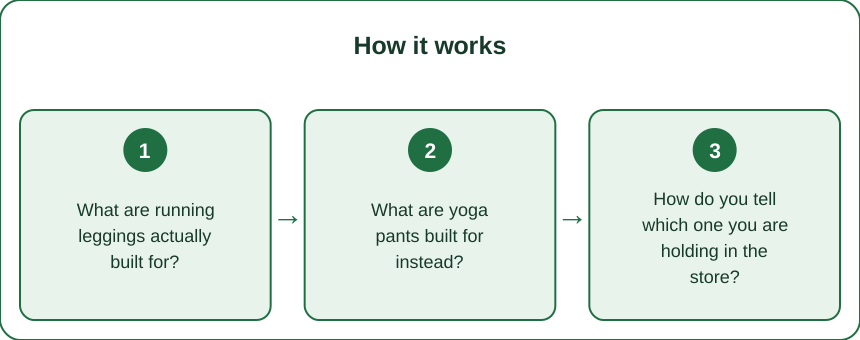
What are running leggings actually built for?
Thousands of identical strides — and every design choice serves that repetition.
Compression is the signature. Running tights hold muscles noticeably tighter than yoga pants, because reducing muscle oscillation over ten thousand strides measurably lowers the felt fatigue and jostle of impact work. That firm, held in feeling is the point on a run — and it is exactly what reads as restrictive the moment you try to melt into a long hip stretch.
The fabric prioritizes moving sweat and surviving miles. Running knits are typically smoother faced, slightly slicker, and quicker drying than yoga fabric, engineered to pull moisture out fast in sustained cardio and to resist the abrasion of pounding pavement in all weather. Durability beats softness in the spec sheet.
The details are logistics for being far from home. A drawcord waist, because a waistband that slips at mile four is a crisis with no fix; zippered pockets sized for keys and gels, because things bounce out of open pockets at stride cadence; reflective hits, because runs outlast daylight; sometimes wind blocking front panels for cold mornings.
And the seams are placed for a stride, routed to avoid rub lines along the inner thigh where thousands of repetitions would find them.
All of it is correct for running and mildly wrong for a mat. The compression resists deep folds, the slick face slides on a mat surface when you want grip, the drawcord knot presses exactly where a belly down pose puts your weight, and the zip pocket announces itself in every twist. Nothing failed — the tool is just visiting the wrong job.
What are yoga pants built for instead?
Range, recovery, and an hour of intimate contact with the floor.
Stretch is the headline spec — but recovery is the real one. A yoga fabric must extend far in every direction for deep lunges and folds, then snap back instantly so the knees are not bagged out by minute twenty. That four way stretch with strong recovery is the defining engineering of the category, and it is also what makes a true yoga pair feel like nothing during a class where a running tight feels like a negotiation.
Softness is functional, not cosmetic. Brushed, buttery-soft finishes exist because yoga presses fabric against your own skin and the mat for an hour — kneeling, rolling, lying — and a slick technical face feels cold and plasticky in that use. The peached hand also grips the mat slightly instead of skating on it.
The waistband does its work upside down. Wide, flat, high-waisted bands hold through inversions and forward folds without hardware, drawcords, or a rolling edge — the fold test in the store, bending fully forward and reaching down, tells you in three seconds what an hour of class would.
Seams flatten and disappear, bonded or flatlocked so nothing presses between bone and floor, and the fabric runs opaque through full flexion — the squat-proof standard matters most in exactly this category, because no activity stretches fabric across more surface at closer viewing distance than a mat class.
The trade offs mirror running’s: softer brushed knits pill faster against pavement grit and velcro, dry slower in hard cardio, and offer no secure pocket — the yoga pant on a long run is just as wrong as the tight in a yin class.
How do you tell which one you are holding in the store?
Five tests, thirty seconds, no label required.
The stretch and snap. Pull the fabric in both directions. Yoga fabric extends generously both ways and springs back sharply; running fabric resists more firmly, especially crosswise, and feels denser under tension. High resistance says run, high range with fast recovery says mat.
The hand test. Close your eyes and touch the inside face. Brushed and warm says yoga; smooth, cool, and slightly slick says running. The interior finish is the single most honest signal in the whole garment.
The waistband interrogation. Drawcord and firm elastic says running. Wide, soft, foldable band with no hardware says yoga. A zip pocket at the back of the band is a running tell nearly every time.
The fold and squat. Bend fully forward, then squat deep in the fitting room. The pair that stays put, keeps its opacity, and disappears from your attention just told you its major. The pair you adjusted on the way up told you the opposite.
The seam trace. Run a thumb along the inner leg and waist seams. Raised overlock stitching leans running durability; flat bonded lines lean yoga floor comfort.
And the honest footnote: the crossover pair exists. A mid weight, high stretch legging with a flat wide waistband, decent recovery, and one zip pocket handles studio plus treadmill plus errands at about eighty five percent each — the correct answer for anyone who owns three leggings, not eight. The dedicated specs earn their place when one activity becomes the activity: marathon training deserves true tights, a real yoga habit deserves a true yoga pair, and the wardrobe sorts itself by what your week actually contains.
What Nobody Tells You About Activity Specific Leggings
Washing erases the differences over time. Fabric softener coats technical wicking knits and kills their function — the running tight that stopped managing sweat was usually softened to death, not worn out. Cold wash, no softener, air dry preserves both categories.
The brand’s own naming is a decoder. Tight and train signal compression and durability; the words soft, lounge, and studio signal brushed low compression fabric. Marketing departments tell the truth in the noun.
Casual wear scrambles the categories completely — for errands and travel, softness wins and nobody needs a drawcord, which is why the yoga pair becomes the daily uniform and the running pair stays in the workout drawer. Buy the everyday pair on comfort, the sport pair on function.
Late summer flips priorities inside each category. Right now, in the last hot weeks, lighter weight and maximum wicking matter most in both camps — this is the season the brushed heavy pair sits out. As September mornings cool, the running side adds wind panels and thermal weights, and the studio side just adds layers over the same pair, which is why the yoga category quietly transitions seasons more cheaply.
Pockets predict behavior. People carry phones to everything now, and the no pocket yoga pair loses errand duty to the pocketed crossover far more often than anyone admits at purchase time.
The wrong pair is still a fine pair. A running tight in one yoga class is an annoyance, not a crisis, and a yoga pant on one easy jog is fine below the distance where bounce and moisture accumulate. The specialization argument is about the dedicated hours, done weekly — that is where the right fabric stops being a detail and becomes the difference between noticing your clothes and forgetting them.
FAQ: Leggings by Activity, Answered
Can one pair really do both well?
At the recreational level, yes — pick a mid weight four way stretch pair with strong recovery, a flat wide waistband, and a zip pocket, and it covers studio, gym, treadmill, and errands honorably. What it will not do is feel invisible in a ninety minute hot yoga class or steady your legs through mile ten. Specialize when one activity turns serious.
Why do my yoga pants go sheer in class but my running tights never do?
Deeper flexion plus lighter fabric. A mat class stretches fabric across the widest surfaces at the closest range, so opacity under full stretch — the squat-proof standard — is a yoga spec first. Test any studio pair with a deep squat in bright light before trusting it in class.
Are compression leggings better for recovery too?
Firm compression worn after hard sessions has modest supportive evidence for reducing soreness, which is a bonus argument for the running tight owning the workout drawer. It is not a reason to stretch in them — recovery lounging wants the soft pair, which you already knew.
Which should I buy first on a budget?
Match the purchase to your most frequent dedicated hour. Three runs a week means tights first; three classes means the yoga pair; a genuine mix means the crossover spec above. The second specialized pair earns its slot when the first one is in the wash more often than the drawer.
TL;DR:
- Running tights are compression, quick dry durability, drawcords, and zip pockets — engineered for ten thousand identical strides.
- Yoga pants are four way stretch with sharp recovery, buttery-soft brushed fabric, flat seams, and a waistband that survives inversions.
- Decode any pair in store with the stretch snap, the interior hand feel, the waistband hardware, and a deep squat and fold.
- One good crossover pair covers a mixed recreational week; dedicated specs earn their place when one activity becomes the serious one.
Next time a pair of black leggings annoys you mid activity, check the inside face with your fingertips. The fabric will confess which class it actually belongs in.
See It in Motion
Seen here: High Waist Embossed Yoga Leggings with Side Pockets — shop it on bubblelime.com
Keep Reading
This article is for general informational and styling purposes only. Fit, sizing, and product availability may vary.